




- My Forums
- Tiger Rant
- LSU Recruiting
- SEC Rant
- Saints Talk
- Pelicans Talk
- More Sports Board
- Winter Olympics
- Fantasy Sports
- Golf Board
- Soccer Board
- O-T Lounge
- Tech Board
- Home/Garden Board
- Outdoor Board
- Health/Fitness Board
- Movie/TV Board
- Book Board
- Music Board
- Political Talk
- Money Talk
- Fark Board
- Gaming Board
- Travel Board
- Food/Drink Board
- Ticket Exchange
- TD Help Board
Customize My Forums- View All Forums
- Show Left Links
- Topic Sort Options
- Trending Topics
- Recent Topics
- Active Topics
Started By
Message
re: Classic Country Jukebox
Posted on 12/7/22 at 2:31 am to fool_on_the_hill

Posted on 12/7/22 at 2:31 am to fool_on_the_hill
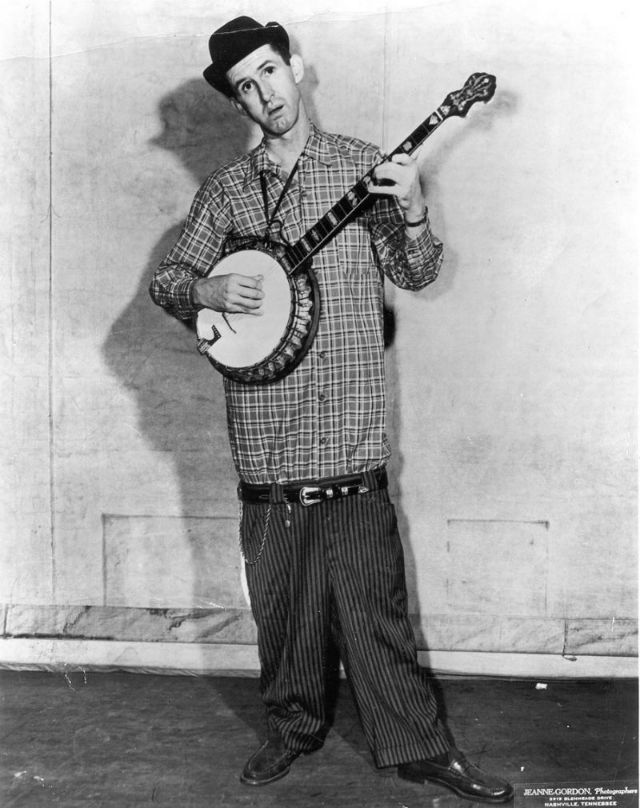
stringbean, apparently a trend setter
 1
1

Posted on 12/7/22 at 2:48 am to fool_on_the_hill


Posted on 12/8/22 at 2:38 pm to fool_on_the_hill
quote:would probably fit better in this thread
stringbean

Posted on 1/22/23 at 6:11 am to Kafka
Posted on 1/31/23 at 6:22 pm to Perfect Circle


Posted on 2/1/23 at 4:08 pm to Kafka
I always recall seeing a Spade Cooley feature film that used to make the rounds on television, "The Kid From Gower Gulch." Made in the late-1940s, I believe. It was a super-cheapo, independently-made film, looking almost more like a home movie. It wasn't so much trying to emulate a b-western as it was trying to ape those postwar Columbia musical-western b-films that invariably starred either Ken Curtis or the Hoosier Hot Shots. Columbia seemed to specialize in some of those, even up to making "Hoedown" (1950) with Eddy Arnold. Those were usually pretty decent films, but Spade Cooley's starring efforts were stinkeroos (although perhaps agreeably interesting as a cultural artifact).

Posted on 2/6/23 at 7:36 pm to DeltaTigerDelta
Posted on 2/23/23 at 2:43 pm to DeltaTigerDelta

Posted on 2/23/23 at 2:49 pm to DeltaTigerDelta
quote:In his classic book Unsung Heroes of Rock & Roll Nick Tosches cited Skeets McDonald's version as proto-rockabilly.
Slim Willet- Don’t let the stars get in your eyes

Skeets singing it live on TV
Posted on 2/23/23 at 2:51 pm to Kafka


Posted on 2/24/23 at 2:57 pm to Kafka


Posted on 2/26/23 at 3:30 pm to Kafka

Posted on 3/15/23 at 3:15 pm to Kafka
March 9, 1963: Smiley Wilson and June Carter, overcome with emotion, cry backstage at the Ryman Auditorium after the Opry's onstage memorial tribute to Patsy Cline, Cowboy Copas, Hawkshaw Hawkins, Randy Hughes, and Jack Anglin, following their deaths earlier in the week.

Posted on 3/31/23 at 3:19 pm to Kafka


Posted on 4/10/23 at 2:19 pm to Kafka


Posted on 4/12/23 at 3:12 pm to Kafka
This rockabilly guy

Would go on to become this rasslin' guy (I kid you not)

Gene Carroll & The Shades - "Is It Ever Gonna Happen"
Would go on to become this rasslin' guy (I kid you not)
Gene Carroll & The Shades - "Is It Ever Gonna Happen"
Posted on 4/15/23 at 4:52 pm to DeltaTigerDelta
Posted on 4/22/23 at 4:16 pm to DeltaTigerDelta

"Move It On Over": Hank Williams Changes Country Music Forever
quote:
There are a lot of moments packed into Hank Williams’ too-brief career when the singer and songwriter would change country music forever. But the first, the one that divides the genre (and American music history) into its pre- and post-Hank eras, took place on April 21, 1947, when Williams recorded “Move It On Over,” his debut single for MGM.
The addictive track, which seamlessly blended a velvety Western swing with the visceral Deep South blues that formed Williams’ musical backbone, would become Williams’ first hit soon after it was released in June of that same year. Besides bringing Williams his first taste of success, the song also anticipated and influenced what would become rock and roll while instantly transforming the era’s “folk” sound
quote:
“Move It On Over” has the contours of a novelty song – after all, it is about asking one’s dog to make room after one has been sent to the proverbial doghouse. Apocryphally, though, its inspiration was quite literal: Williams’ wife and manager Audrey would lock him out of the house after one too many late nights. Also apocryphal is the oft-told tale that this was the song that made Fred Rose, prolific songwriter and co-founder of Acuff-Rose publishing, promote Williams from his publishing contract to a bona fide record deal.
The recording
Less mythic are the song’s musical sources, which stretch back to the dawn of the recorded blues. The specific melody Williams uses over a classic 12-bar blues form has its roots in “one of the first hits in recorded Black music,” as critic and historian David Hajdu describes it in his book Love For Sale. That hit was “Jim Jackson’s Kansas City Blues,” recorded by Jim Jackson in 1927. It would be transformed by blues pioneer Charley Patton into “Going To Move To Alabama” in 1929 and then ten years later by bandleader and composer Count Basie into “Your Red Wagon” before Williams found success with his own interpretation — which gleaned just a hint of the Basie take’s cosmopolitan slickness to polish up its decidedly relatable lyrics and Williams’ bluesy inflection.
quote:
The smooth sound came courtesy of Red Foley’s backing band, who were brought into Williams’ first session for the label after his own band proved to be a little more ready for a roadhouse than that era’s Nashville recording studios. The resulting single, still striking decades later, is impeccable in almost every regard, from its tempo – somehow rollicking and sultry at once – to its big-band-inspired call and response, to its jazzy guitar solo and pedal steel filigree, to – of course – Williams’ effortless swing with a barely detectable strain of blue yodel.
The reception
“Move It On Over” was a near-instant hit, reportedly selling over 100,000 copies within a few months. It only reached No. 4 on Billboard’s country chart (then called “Most Played Jukebox Folk Records”), but its success was enough to bring Williams both his first press and his first substantive paychecks: he rapidly put a down payment on a house, bought himself a car and his wife her first fur coat. It was the first song he played when he joined the Louisiana Hayride in 1948, and remained his signature hit until he recorded “Lovesick Blues” in 1949.
The song has been recorded numerous times (notably a few decades later by George Thorogood and the Destroyers) but its real legacy is probably in 1955 single “Rock Around The Clock” – the first mainstream rock song, in which Bill Haley & His Comets retooled that same arpeggiated blues melody that Williams used to such great effect here.
Posted on 4/24/23 at 2:21 pm to DeltaTigerDelta
Posted on 6/1/23 at 4:24 pm to sodcutterjones


 Page 25 of 51

Popular
Back to top
 Follow TigerDroppings for LSU Football News