




- My Forums
- Tiger Rant
- LSU Recruiting
- SEC Rant
- Saints Talk
- Pelicans Talk
- More Sports Board
- Coaching Changes
- Fantasy Sports
- Golf Board
- Soccer Board
- O-T Lounge
- Tech Board
- Home/Garden Board
- Outdoor Board
- Health/Fitness Board
- Movie/TV Board
- Book Board
- Music Board
- Political Talk
- Money Talk
- Fark Board
- Gaming Board
- Travel Board
- Food/Drink Board
- Ticket Exchange
- TD Help Board
Customize My Forums- View All Forums
- Show Left Links
- Topic Sort Options
- Trending Topics
- Recent Topics
- Active Topics
Started By
Message
The Buffett Indicator Is Hitting a Level Seen Only 3 Times in the Past 60 Years.
Posted on 1/13/26 at 10:02 am


Posted on 1/13/26 at 10:02 am
quote:

The Buffett Indicator Is Hitting a Level Seen Only 3 Times in the Past 60 Years. History Says What Happens Next Won't Be Good.
David Dierking, The Motley Fool
January 11, 2026
Key Points
• The ratio comparing total U.S. market cap to GDP, known as the Buffett Indicator, is reaching historic levels, both in absolute and relative terms.
• Its current reading of 230% is far beyond any peak level we've seen.
• All three previous instances of the Buffett Indicator getting this stretched were followed by declines of at least 25%.
By most measures, the U.S. stock market is expensive right now. That shouldn't come as a surprise.
The S&P 500 (SNPINDEX: ^GSPC) trades at around 31 times earnings, a level reached during just a few periods since the late 1800s. The Shiller CAPE Ratio, which measures average inflation-adjusted earnings from the prior 10 years, just hit 40. The only other time it's hit that mark in the last 150 years was during the heights of the tech bubble.
Another popular signal is the Buffett Indicator. Given that the guy who created it is considered one of the most successful investors ever, Wall Street tends to pay attention to it.
Unfortunately, if history is any guide, it's sending a big red flag warning.
What the Buffett Indicator measures
The Buffett Indicator compares total U.S. stock market capitalization to U.S. GDP. In essence, it's asking how large the stock market is relative to the size of the U.S. economy that supports it. Warren Buffett himself once called it "probably the best single measure of where valuations stand at any given moment."
For decades, the indicator hovered in a range mostly between about 40% and 100%. It crossed above the 100% level for the first time in the late 1990s as the tech bubble began picking up steam. Following bouts of volatility then and during the financial crisis, the Buffett Indicator has continued to move higher and set new records.
Currently, that ratio sits at 230%, an all-time high and about 77% above its long-term trend line.
What the indicator is telling us right now
While the absolute level of this indicator is staggering enough on its own, its relative level is the real warning signal.
For just the fourth time in the past 60 years, the Buffett Indicator is sitting two standard deviations above its historical trend line.
...
Again, I don't think we're looking at an imminent bear market here. Underlying macroeconomic conditions are still looking favorable, so there could be support for the S&P 500 here. But I think investors should realize that future returns are likely to be much different than returns over the past three years. And volatility is likely to return at several points along the way.
This isn't a crash signal, but it is a warning. Valuations still matter, and investors should keep this in mind.
LINK
 3
3


Posted on 1/13/26 at 11:11 am to NC_Tigah
The market is front running an expected GDP boom. This boom should reduce the ratio over time as the denominator gets larger. There isn’t a requirement for a market correction to correct the ratio.

Posted on 1/13/26 at 12:30 pm to Upperdecker
Sell everything!!!


Posted on 1/13/26 at 12:38 pm to StonewallJack
quote:
Sell everything!!!
I’m very interested to see what happens during the next bear market or bubble burst. I think i read that almost over 25% of the market is made up of retail investors which is the largest percentage in history. And retail at this point has been conditioned to “buy the dip”. Institutional investors have to account for that and follow suit to a certain extent.
I’m not sure if that holds off a bubble burst, leaves on or the other holding the bag, or doesn’t impact anything at all. Should be interesting though.
Posted on 1/14/26 at 1:07 pm to NC_Tigah
The biggest driver of the market valuation is big tech and AI. Those companies are global companies. The Buffett Indicator is comparing their global value to domestic production.

Posted on 1/14/26 at 6:57 pm to StonewallJack
quote:
Sell everything!!!
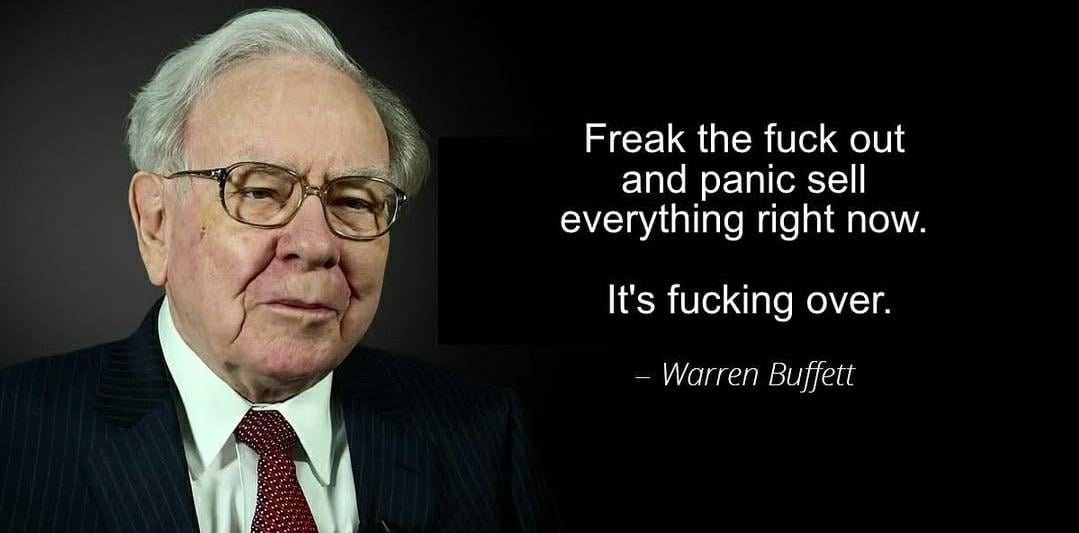

Posted on 1/14/26 at 7:08 pm to AaronDeTiger
quote:Indeed
The biggest driver of the market valuation is big tech and AI. Those companies are global companies. The Buffett Indicator is comparing their global value to domestic production.


Posted on 1/14/26 at 8:04 pm to FAT SEXY
Is that fareplay 
Posted on 1/14/26 at 8:43 pm to Suntiger
We saw it in 2022.
I think retail will hold up ok. Maybe not the Robinhood retail, but the Vanguard type.
I think retail will hold up ok. Maybe not the Robinhood retail, but the Vanguard type.
Posted on 1/14/26 at 8:57 pm to Suntiger
quote:yes that and retail investors have unprecedented access. Now everybody can trade on their phone in seconds while waiting for coffee.
I’m very interested to see what happens during the next bear market or bubble burst. I think i read that almost over 25% of the market is made up of retail investors which is the largest percentage in history. And retail at this point has been conditioned to “buy the dip”. Institutional investors have to account for that and follow suit to a certain extent.

Posted on 1/14/26 at 9:53 pm to NC_Tigah
These kind of metrics are very useful for predicting that significant pullbacks are likely but they’re terrible timing tools, and therein lies the rub.

 Page 1 of 1


Back to top
 Follow TigerDroppings for LSU Football News