




- My Forums
- Tiger Rant
- LSU Recruiting
- SEC Rant
- Saints Talk
- Pelicans Talk
- More Sports Board
- Winter Olympics
- Fantasy Sports
- Golf Board
- Soccer Board
- O-T Lounge
- Tech Board
- Home/Garden Board
- Outdoor Board
- Health/Fitness Board
- Movie/TV Board
- Book Board
- Music Board
- Political Talk
- Money Talk
- Fark Board
- Gaming Board
- Travel Board
- Food/Drink Board
- Ticket Exchange
- TD Help Board
Customize My Forums- View All Forums
- Show Left Links
- Topic Sort Options
- Trending Topics
- Recent Topics
- Active Topics
Started By
Message
re: Carley McCord plane crash report reveals propeller problem
Posted on 9/17/21 at 1:39 am to Got Blaze

Posted on 9/17/21 at 1:39 am to Got Blaze
quote:
That missing gauge can provide exact, valuable information to confirm the cause of accident
With analog instruments of this type crash investigators will look for things like a tiny mark on the instrument’s face that would be made by the pointer making physical contact with the face due to the g-force from the crash impact. They will assume that was what the instrument was indicating at the time of the crash. You are correct, even at this time, if found the missing engine gauge could provide valuable information.
 0
0


Posted on 9/17/21 at 2:07 am to jamboybarry
quote:
Weird say to say the engines failed
If it was a propeller, then I highly doubt the engine was failing too. Props and engines are different systems. I’d gladly take a failed engine with a feathered prop over a functioning engine with a fricked prop. A malfunctioning propeller is a shitty situation and will kill you if you can’t get it under control.
That baw was dealing with low ceilings and a malfunctioning propeller, and he was flying single pilot. That’s a shite arse situation.
I will say that that airplane’s OEI(one engine inoperative) performance was probably skosh at best with all those people and luggage aboard.
Posted on 9/17/21 at 2:29 am to jcaz
quote:
Hoping some turbine pilots on here can digress. Wonder if the prop control (blue levers) next to throttle was set at wrong bite
I don’t really trust lay people to say an airplane sounded like this or that before it hit the ground(based on the info in the OP). However, I doubt he had the props at the wrong setting. I’m a little out of my lane here(turboprop Herk guy), but I have flown some GA with variable pitch propellers, and IIRC you just set them full forward for takeoff. Not saying it’s out of the realm of possibility, just not likely.
quote:
You’d think this issue would be known on takeoff roll.
Not the case, you never know when a man made piece of equipment is going to shite the bed on you.
All this to say, I suspect a mechanical failure.


Posted on 9/17/21 at 2:42 am to HerkFlyer
quote:
don’t really trust lay people to say an airplane sounded like this or that before it hit the ground(based on the info in the OP)
Eye (ear) witnesses are notoriously unreliable.
quote:
However, I doubt he had the props at the wrong setting. I’m a little out of my lane here(turboprop Herk guy), but I have flown some GA with variable pitch propellers, and IIRC you just set them full forward for takeoff. Not saying it’s out of the realm of possibility, just not likely
Correct. Full forward on the prop controls and full forward on the power for takeoff. Hard to miss that following a checklist.
During runup you’re supposed to do a prop feather check: at 1500rpm place prop levers in feather, then low pitch allowing no more than a 500 rpm drop. (can vary from aircraft to aircraft)
I haven’t read everything, but wonder if the survivor can recall any runup abnormalities before takeoff.


Posted on 9/17/21 at 7:07 am to HerkFlyer
quote:
don’t really trust lay people to say an airplane sounded like this or that before it hit the ground(based on the info in the OP
In the report they take you through how they were able to determine approxikate prop RPM by analyzing audio frequency from two audio recordings on the ground that the plane flew over.
This post was edited on 9/17/21 at 7:58 am
Posted on 9/17/21 at 8:07 am to jamboybarry
quote:
Weird say to say the engines failed
Maybe the engines didn't fail, but rather the mechanism that controls the constant speed propellers.

Posted on 9/17/21 at 8:15 am to Tchefuncte Tiger
Is the turn back to the airport attributed to the pilot intentionally or due to reaction to the airplane? It’s best to try and level off with engine/ prop/ mechanical issues right? Turning reduces lift and can cause a stall?
Posted on 9/17/21 at 8:41 am to HerkFlyer
quote:
All this to say, I suspect a mechanical failure.
Ah ok so likely a mechanism of some sort failed causing the prop control to fail on one side? Maybe differential thrust was a lot to handle in likely IMC? Then while trying to diagnose the issue maybe spatial disorientation?
Posted on 9/17/21 at 8:53 am to baldona
There was a twin engine crash last year ((Texas IIRC). Caught on video.
One engine failed during takeoff. Pilot had no chance to recover. Violent rollover. Crashed in just a few seconds. Awful.
My guess is Higgs was hoping to get back to the airstrip.
One engine failed during takeoff. Pilot had no chance to recover. Violent rollover. Crashed in just a few seconds. Awful.
My guess is Higgs was hoping to get back to the airstrip.
Posted on 9/17/21 at 9:50 am to Tchefuncte Tiger
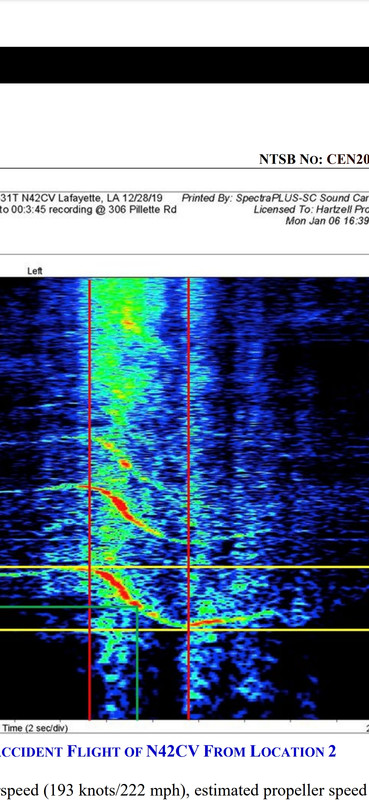
As I said in my previous post there are two audio recordings from the ground that confirms the props were turning at approximately 2000 rpm. It's in the 52 page section of the NTSB report.
quote:
FIGURE 9 is the acoustic (sound) spectrum from location 2; the horizontal yellow lines graphically define
the approximate high and low frequency range of one propeller as it passes the stationary recording location 2
almost directly overhead. The vertical red lines represent the time interval with the high-low frequency range;
this time interval was about 4 seconds. The visual midpoint of the time interval was used to approximate when
the airplane was over location 2; the corresponding frequency was visually about 137-140 HZ depicted by the
green line. For a 4-bladed propeller rotating at 2,000 rpm the frequency should be 133.33 HZ for one propeller
and for that same propeller rotating at 2,100 rpm the frequency should be 140 HZ; thus, the sound spectrum
acoustic signatures from location 2 were consistent with both propellers rotating at a speed lower than maximum
(2,200 rpm) and closer to about between 2,000 and 2,100 rpm.
This post was edited on 9/17/21 at 10:02 am

Posted on 9/17/21 at 10:42 am to mtntiger
quote:
There was a twin engine crash last year ((Texas IIRC). Caught on video.
kingair in DFW area?
Posted on 9/17/21 at 1:06 pm to 777Tiger
quote:
kingair in DFW area?
I think that's the one. Slammed into a building off the end of the runway.
Looked like someone flipped a pancake. Those people had no chance to recover. From start of the roll to crash was 2 seconds tops.
Whatever happened to the McCord Ensminger plane gave the pilot hope of getting it back home it seems. Guessing he thought he could maintain airspeed but obviously could not.
Armchair QB in me wonders if there might have been a field on his planned flight path where he might have tried to ditch instead of doing a 180.

Posted on 9/17/21 at 1:08 pm to mtntiger
I would have never gotten into a 40 year old plane.
Posted on 9/17/21 at 1:28 pm to mtntiger
quote:The wing stalled. Is there any way to prevent the wing from stalling under single engine flight?
Looked like someone flipped a pancake.
Posted on 9/17/21 at 2:13 pm to dukke v
quote:
I would have never gotten into a 40 year old plane.
Age is the probably the least indicative of the condition of a plane, especially in general aviation. The 40 year old plane my have newer engines, props, and the airframe fewer takeoff/landing/pressurization cycles than a 10-15 year old plane of the same type.

Posted on 9/17/21 at 2:16 pm to EA6B
So what you're saying is: as usual, Peej has no idea what he's talking about and is dead wrong?
This post was edited on 9/17/21 at 2:17 pm
Posted on 9/17/21 at 2:19 pm to mtntiger
They took off over gross and had the worst case scenario happen to them. Read some report, don’t have it handy, but iirc, auto feather system was inop. and pilot either had a delayed or incorrect reaction. Co-pilot was the son of a guy I work with that was building flight time.
Posted on 9/17/21 at 2:33 pm to TigerstuckinMS
GFY.
Posted on 9/17/21 at 2:41 pm to redstick13
quote:
thus, the sound spectrum
acoustic signatures from location 2 were consistent with both propellers rotating at a speed lower than maximum
(2,200 rpm) and closer to about between 2,000 and 2,100 rpm.
Is that enough to cause a crash? That's under 10% less thrust? Doesn't seem like enough to cause a major issue? And that's both of them? So doesn't seem like a propeller issue to me then? But more likely an issue with both engines?
I'm curious how often these small planes have issues like this that are recovered safely.
Posted on 9/17/21 at 6:21 pm to baldona
quote:
Is that enough to cause a crash? That's under 10% less thrust?
Thrust vs prop RPM is not a linear relationship, thrust is proportional to the square of the RPM.
This post was edited on 9/17/21 at 6:34 pm

 Page 3 of 4

Popular
Back to top
 Follow TigerDroppings for LSU Football News