




- My Forums
- Tiger Rant
- LSU Recruiting
- SEC Rant
- Saints Talk
- Pelicans Talk
- More Sports Board
- Winter Olympics
- Fantasy Sports
- Golf Board
- Soccer Board
- O-T Lounge
- Tech Board
- Home/Garden Board
- Outdoor Board
- Health/Fitness Board
- Movie/TV Board
- Book Board
- Music Board
- Political Talk
- Money Talk
- Fark Board
- Gaming Board
- Travel Board
- Food/Drink Board
- Ticket Exchange
- TD Help Board
Customize My Forums- View All Forums
- Show Left Links
- Topic Sort Options
- Trending Topics
- Recent Topics
- Active Topics
Started By
Message
re: UPS plane crashes in Louisville?
Posted on 11/8/25 at 9:56 pm to BHM

Posted on 11/8/25 at 9:56 pm to BHM
I know Turbine Seperation seems to be the most likely but this is an interesting coincidence if it ends up not being a factor.
Wave3.com
Wave3.com
quote:
FAA records show maintenance workers repaired a crack on the crashed UPS plane’s left engine pylon in 2019. The NTSB said Friday the bulk of that pylon was still attached to the engine when it detached from the plane during its takeoff roll leading up to the Nov. 4, 2025 deadly crash.
 1
1

Posted on 11/9/25 at 8:23 am to goldennugget
My wife’s car that was parked at SDF and it was oil spots all over the vehicle.


Posted on 11/9/25 at 11:57 am to BHM
quote:
Luckily turbine seperation is not a common engine failure.
I suspect that there will be shortcuts, false or shoddy maintenance involved.


Posted on 11/15/25 at 9:28 am to Auburn1968
This is so interesting. If it was just a maintenance issue, would they be grounding all of these airplanes?
quote:
FAA EXTENDS MD-11 GROUNDING TO DC-10 FAMILY AFTER ENGINE DETACHMENT INCIDENT
The FAA has expanded Emergency AD 2025-23-51—originally issued on November 8, 2025 for all MD-11 and MD-11F aircraft—to now include multiple MD-10 and DC-10 variants, citing shared engine-pylon structures.
This action follows a serious accident in which the left-hand engine and pylon detached during takeoff. The root cause is still under investigation, but the FAA warns the unsafe condition could lead to loss of continued safe flight and landing.
The grounding now covers:
• MD-11 / MD-11F
• MD-10-10F / MD-10-30F
• DC-10-10, -10F, -15, -30, -30F (incl. KC-10A & KDC-10), DC-10-40, DC-10-40F
All affected aircraft are prohibited from further flight until inspections and corrective actions are completed using an FAA-approved method.
Loading Twitter/X Embed...
If tweet fails to load, click here.Posted on 11/15/25 at 9:36 am to When in Rome
quote:
If it was just a maintenance issue, would they be grounding all of these airplanes?
Saw a video explaining how the engine maintenance procedure was so time consuming and costly to get the engine off that it heavily incentivized shortcuts that could cause premature failure in the pylons through error or wear over time.
If true, this grounding forces everyone to check for signs of that failure and correct, while also making sure the grease monkeys aren't taking the shortcuts.
One possible explanation, at least.
Posted on 11/15/25 at 9:47 am to forkedintheroad
That makes sense.
Posted on 11/20/25 at 10:43 am to forkedintheroad
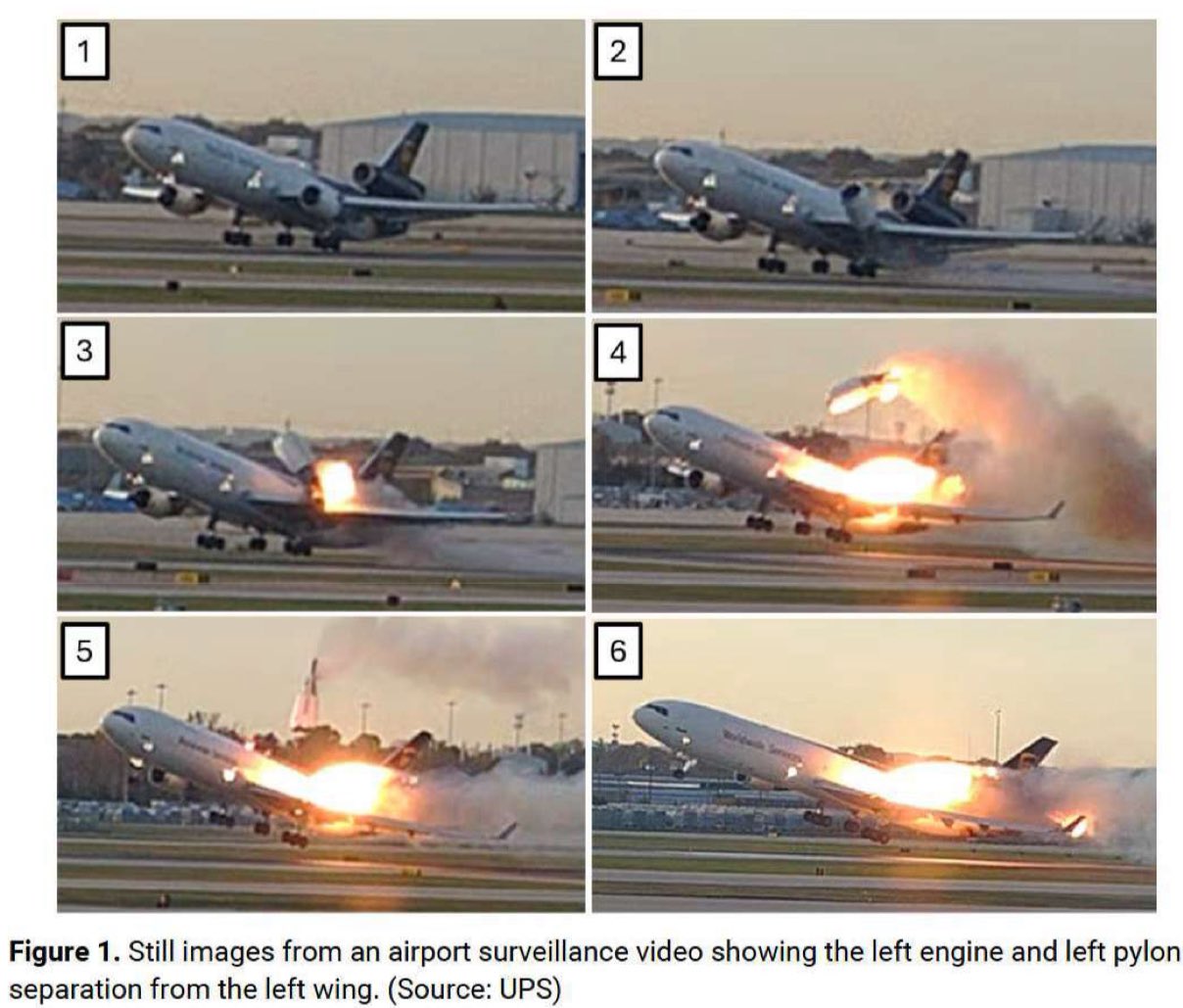
Posted on 11/20/25 at 10:47 am to When in Rome
Wow those stills of the engine ripping off are crazy. They never even stood a chance at that point
Posted on 11/20/25 at 10:48 am to When in Rome
Those pics are crazy. The original far away video looked like the fire was on the roll, but seeing now it ripped off while rotating.
This post was edited on 11/21/25 at 7:34 am
Posted on 11/20/25 at 10:51 am to When in Rome
those poor bastards


Posted on 11/20/25 at 10:53 am to DCtiger1
quote:Everything was normal until the nose lifted and then all hell broke loose. Nothing the pilots could have done. Awful.
They never even stood a chance at that point

This post was edited on 11/20/25 at 10:58 am


Posted on 11/20/25 at 10:57 am to When in Rome
quote:
At the time of the accident, N259UP had accumulated a total time of about 92,992 hours and
21,043 cycles. The accident airplane was maintained under a continuous airworthiness
maintenance program (CAMP). A review of the inspection tasks for the left pylon aft mount
found both a general visual inspection (GVI) and a detailed visual inspection of the left pylon
aft mount, required by UPS's maintenance program at a 72-month interval, was last
accomplished on October 28, 2021. A 24-month/4,800 hour lubrication task of the pylon thrust
links and pylon spherical bearings was last accomplished on October 18, 2025. A special
detailed inspection (SDI) of the left pylon aft mount lugs would have been due at 29,200 cycles
and of the left wing clevis support would have been due at 28,000 cycles. The accident
airplane records showed these two SDI tasks had not been accomplished (the airplane had
21,043 cycles).
This post was edited on 11/20/25 at 10:58 am
Posted on 11/20/25 at 10:57 am to Crow Pie
quote:
They never even stood a chance at that point
Everything was normal until the nose lifted and then all hell broke loose. Nothing the pilots could have done. Awful.
the engine separating by itself isn't catastrophic, if it somehow flew up into the #2 engine, it's all over, haven't really dug into this one to see if that's what happened
Posted on 11/20/25 at 11:12 am to 777Tiger
quote:I added a pic from the report to my post above.. Is pretty easy to see how the tail engine would not survive the initial incident. Looks like the #1 engine hit the fuselage right in front of the tail engine.
the engine separating by itself isn't catastrophic, if it somehow flew up into the #2 engine, it's all over, haven't really dug into this one to see if that's what happened
This post was edited on 11/20/25 at 11:14 am
Posted on 11/20/25 at 11:13 am to Saintsisit
The pics also seem to show an intact engine departing. I see no indication of turbine failure which may have damaged the engine mounts. All the cowlings seem to be without damage.
Posted on 11/20/25 at 11:16 am to BHM
quote:It looks like the #1 engine fell off/tore off, then the fuel line separated and ..catastrophic fire.
The pics also seem to show an intact engine departing. I see no indication of turbine failure which may have damaged the engine mounts. All the cowlings seem to be without damage.

Posted on 11/20/25 at 11:24 am to 777Tiger
quote:
the engine separating by itself isn't catastrophic, if it somehow flew up into the #2 engine, it's all over, haven't really dug into this one to see if that's what happened
Exactly
If #2 FOD’d out from the seperation debris that poor flight crew never stood a chance.
Looked to me like the bird, while on fire was destined to crash, the worst issue during decent was striking those powerlines while leaking fuel from the wings. On the videos it looked like the fireball occurred after that part of the crash and not the impending ground impact
This post was edited on 11/21/25 at 5:27 am

Posted on 11/20/25 at 11:28 am to Crow Pie
quote:
I added a pic from the report to my post above.. Is pretty easy to see how the tail engine would not survive the initial incident. Looks like the #1 engine hit the fuselage right in front of the tail engine.
Those pictures are wild. Very sad.

Posted on 11/20/25 at 11:30 am to BluegrassBelle
quote:Maybe I'm reading this wrong, but wouldn't this mean the maintenance wasn't overdue?
A special
detailed inspection (SDI) of the left pylon aft mount lugs would have been due at 29,200 cycles
and of the left wing clevis support would have been due at 28,000 cycles. The accident
airplane records showed these two SDI tasks had not been accomplished (the airplane had
21,043 cycles).
Posted on 11/20/25 at 11:32 am to The Mick
You are correct. I’m sure that 29,200 number will soon be changed.

 Page 15 of 16

Popular
Back to top
 Follow TigerDroppings for LSU Football News